2021 Volkswagen Golf MK8 eTSI CSF3 V2 fitment
A recorded LFI customer specification. Final width, offset, tyre pairing, ride height, hardware seat and load specification are confirmed against the actual vehicle at order time.

 Volkswagen Golf / GTI / Golf R
Customer-specification fitment guide for the Volkswagen Golf / GTI / Golf R. 5x112, 57.1, hub-centric — referenced against recorded LFI customer builds and specified from the car outward.
LFI forged wheels for the Volkswagen Golf / GTI / Golf R use 5x112 PCD, 57.1 centre bore, 690 kg load target, 1,300 Nm torque target, with width, offset, tyre support, and brake clearance matched to the actual car before production.
GTI vs Golf R
Brake size, ride height and tyre target can differ enough that copying an eTSI, GTI or R setup without review is risky.
57.1 hub-centric fit
Centre bore and bolt-seat details are confirmed so the wheel mounts cleanly instead of depending on loose universal assumptions.
Daily-friendly stance
For Singapore roads, LFI prioritises steering lock, fender clearance and tyre diameter alongside visual flushness.
MQB fitment basics: Golf, GTI and Golf R builds need 5x112 PCD, 57.1 mm centre bore, correct wheel-bolt seat, brake clearance, and tyre diameter confirmed before machining. LFI separates daily road fitment from aggressive Golf R or big-brake setups before production.
Chassis-Matched
Width, offset, and concavity specified to the vehicle — specified from measured vehicle requirements rather than shelf-size assumptions.
Brake Clearance
Spoke profile, barrel contour, and backpad machined to the brake package on the exact car.
Forged Response
Lower unsprung mass sharpens steering, braking feel, and ride control — immediately noticeable from the first drive.
| Area | Guide value | Fitment note |
|---|---|---|
| PCD | 5x112 | Confirmed at order time. |
| Centre bore | 57.1 | Machine hub-centric to the confirmed car. |
| Wheel sizes | 19x8 ET38 / 17x8.5 ET42 / 18x8.5 ET45 / 19x9 ET40 | Confirmed at order time. |
| Wheel models | LFI forged wheel / TE37SL / MF151 / MF110 | Face profile is selected around brake clearance and load specification. |
A recorded LFI customer specification. Final width, offset, tyre pairing, ride height, hardware seat and load specification are confirmed against the actual vehicle at order time.
The primary row is drawn from recorded LFI build data. Alternate rows are specification directions — brake template, tyre shoulder, load target, and ride height are confirmed at order time.
| Direction | Wheel size | Wheel model | Best for | Notes |
|---|---|---|---|---|
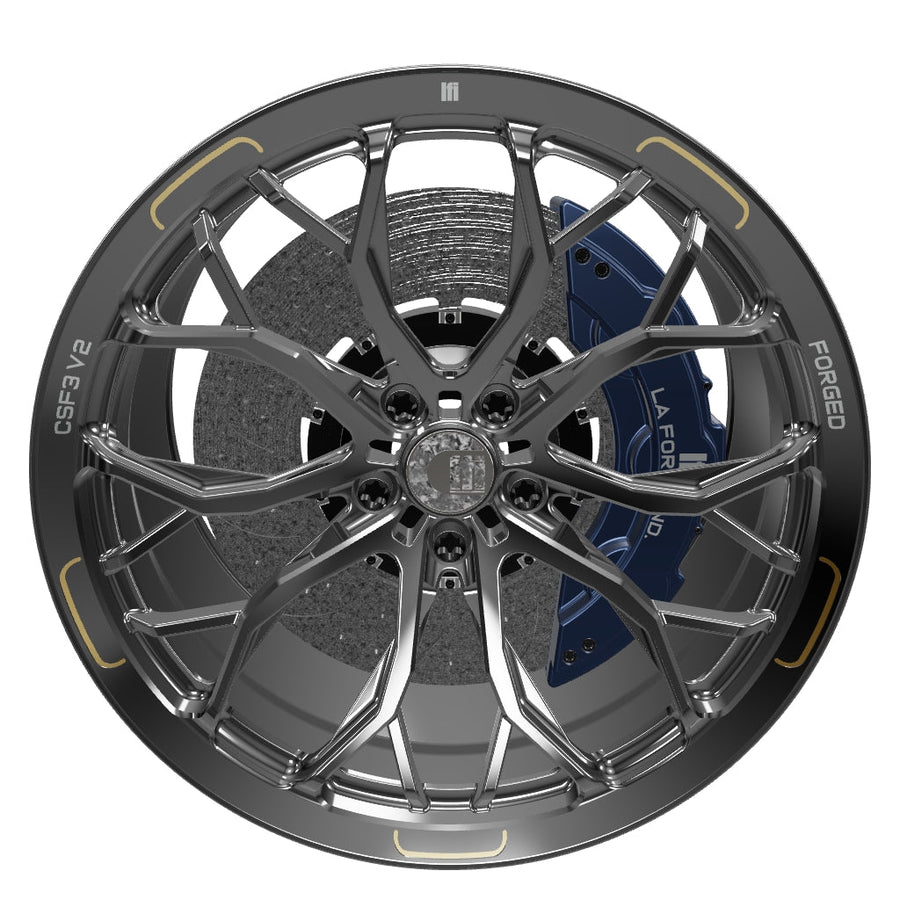
| Primary | 19x8 ET38 | CSF3 V2 | Recorded MK8 eTSI fitment | Recorded customer build - confirm tyre shoulder, brake template, ride height, and final offset. |
| Alternate | 17x8.5 ET42 | TE37SL | Customer-proven direction | Recorded customer build - confirm tyre shoulder, brake template, ride height, and final offset. |
| Additional | 18x8.5 ET45 | MF151 | Customer-proven direction | Recorded customer build - confirm tyre shoulder, brake template, ride height, and final offset. |
Wheel strength is not a single number. Vertical load, braking torque, drive torque, spoke-root stress, hub-pad stress, and bolt-seat behavior are all part of the engineering package — validated together, not in isolation.
The Volkswagen Golf / GTI / Golf R has a verified GAWR of 1050 kg — 525 kg per wheel at the axle. LFI targets 690 kg per wheel, providing meaningful reserve.
Wheel strength is broader than vertical load. LFI also reviews acceleration, braking, cornering, potholes, tyre grip, hub-pad stress, bolt-seat stress, spoke-root stress, and rim-barrel torque reaction against an approximately 1,300 Nm per wheel static torque load target.
For the full engineering story behind each wheel, LFI's How LFI Wheels Are Made page covers design, forging, CNC machining, finishing, and quality control.
| Wheel load rating | Per-axle equivalent | Margin vs axle baseline | Status | How LFI positions it |
|---|---|---|---|---|
| 690 kg | 1380 kg per axle | +31% vs 525 kg/wheel | Green - Preferred | Street, fast-road, and daily use. |
| 790 kg | 1580 kg per axle | +50% vs 525 kg/wheel | Blue - Extra reserve | High-speed, harsh-road, heavy tyre, or extra reserve. |
| 890 kg | 1780 kg per axle | +70% vs 525 kg/wheel | Blue - Extra reserve | High-speed, harsh-road, heavy tyre, or extra reserve. |
| 950 kg | 1900 kg per axle | +81% vs 525 kg/wheel | Blue - Extra reserve | High-speed, harsh-road, heavy tyre, or extra reserve. |
| Validation load case | Reference basis | Suggested LFI target | Why it matters |
|---|---|---|---|
| Radial vehicle load | Vehicle mass, passengers, tyre package, and selected wheel load specification | 690 kg preferred target | Vehicle mass and sustained road loading. |
| Torque load | Conservative 1g dry braking check with 60% front bias | ~1,300 Nm per wheel | Loads the hub pad, bolt seats, spoke roots, and rim barrel. |
| Cornering load | Lateral force from road grip, sticky tires, and fast-road or track use | Application-specific | Lateral loading under cornering. |
| Combined static load case | Radial load + torque load + cornering load | Application-specific | Real-world loads are combined, not isolated. |
Engineering Article
For forged wheel applications, vertical load is one part of the engineering picture. LFI also reviews spoke-root stress, hub-pad loading, bolt-seat behavior, rim-barrel stress, and combined static road-load cases where relevant.
| Term | Meaning | How it applies to LFI custom wheels |
|---|---|---|
| JWL | Japanese technical standard for light alloy wheels. | Used as a reference standard for relevant load and durability requirements. |
| VIA | Japanese third-party wheel registration and verification system. | Applies only to specific wheel models/specifications that are formally registered. |
| TUV | European technical testing or certification framework. | Applies only when a specific wheel/specification has supporting TUV documentation. |
| SAE | Common industry test framework for aftermarket wheel performance and impact evaluation. | Useful for impact and fatigue validation depending on market and specification. |
| Internal validation | LFI's own engineering and test process. | Used for bespoke specifications built from validated design families. |
| Static FEA | Computer-based engineering simulation. | Used before machining to evaluate stress, weight, torque load, and clearance. |
Reference Golf, GTI, and Golf R wheel families may carry JWL / VIA or third-party lab documentation. Your MQB specification is still reviewed for 5x112 fitment, 57.1 mm hub-centric machining, brake clearance, load target, and torque load before machining. See LFI's Testing & Compliance for published standards and test references.


A recorded LFI customer specification. Final width, offset, tyre pairing, ride height, hardware seat and load specification are confirmed against the actual vehicle at order time.
This is an actual LFI customer build record. Installed photos will be added once the customer provides them.
A recorded LFI customer specification. Final width, offset, tyre pairing, ride height, hardware seat and load specification are confirmed against the actual vehicle at order time.
This is an actual LFI customer build record. Installed photos will be added once the customer provides them.
A recorded LFI customer specification. Final width, offset, tyre pairing, ride height, hardware seat and load specification are confirmed against the actual vehicle at order time.
This is an actual LFI customer build record. Installed photos will be added once the customer provides them.
A recorded LFI customer specification. Final width, offset, tyre pairing, ride height, hardware seat and load specification are confirmed against the actual vehicle at order time.
This is an actual LFI customer build record. Installed photos will be added once the customer provides them.
A recorded LFI customer specification. Final width, offset, tyre pairing, ride height, hardware seat and load specification are confirmed against the actual vehicle at order time.
This is an actual LFI customer build record. Installed photos will be added once the customer provides them.
A recorded LFI customer specification. Final width, offset, tyre pairing, ride height, hardware seat and load specification are confirmed against the actual vehicle at order time.
This is an actual LFI customer build record. Installed photos will be added once the customer provides them.
A recorded LFI customer specification. Final width, offset, tyre pairing, ride height, hardware seat and load specification are confirmed against the actual vehicle at order time.
This is an actual LFI customer build record. Installed photos will be added once the customer provides them.
A recorded LFI customer specification. Final width, offset, tyre pairing, ride height, hardware seat and load specification are confirmed against the actual vehicle at order time.
This is an actual LFI customer build record. Installed photos will be added once the customer provides them.
A recorded LFI customer specification. Final width, offset, tyre pairing, ride height, hardware seat and load specification are confirmed against the actual vehicle at order time.
This is an actual LFI customer build record. Installed photos will be added once the customer provides them.
These wheel models are selected around the vehicle type instead of a catalogue forged-wheel fallback.

Open motorsport layout for brake cooling and compact performance cars.
Clean performance styling for compact and daily builds.

Responsive lightweight road and track fitments.
LFI supports Volkswagen Golf GTI / Golf R Singapore customers with vehicle-specific forged wheel consultation, DDP supply where available, and direct Singapore / Malaysia support. Fitment recommendations are based on the confirmed vehicle, brake package, tyre target, load requirement, and intended use.
LFI helps owners choose between OEM+, lightweight square, brake-clearance, show-style, and track-focused forged setups.
City roads, highways, potholes, wet-weather tires, ride comfort, and tyre availability can all change the best wheel and tyre recommendation.
DDP shipping available to major markets. The price quoted is the price paid — no surprise duties or taxes on delivery.
Singapore customers can visit LFI at 76 Playfair Road, #01-03, Singapore 367996 to view forged wheel samples, finishes, concavity profiles, and selected in-stock wheels.
Malaysia customers can order directly with LFI and request pre-production consultation for road use, track use, tyre availability, and brake clearance.
| Reference | What it supports | Link |
|---|---|---|
| Owner Manual / VIN Data | Factory tyre, wheel, tyre-pressure, and axle-label information for the exact vehicle. | Owner Manual / VIN Data |
| JWL / VIA Wheel Standards | Japanese light-alloy wheel standard and third-party verification context for JWL / JWL-T marking and VIA registration. | Japan Light Alloy Automotive Wheel Testing Council |
| TUV SUD Wheel Testing | Independent laboratory testing context for wheels, materials, components, fatigue testing, impact testing, and international wheel standards. | TUV SUD Wheel Testing |
| Standards Testing Laboratories | Automotive wheel test-lab context for fatigue, impact, load / deflection, and compliance-related validation. | STL Testing Services |
| SAE J2530 | Aftermarket passenger-car and light-truck wheel performance requirements and test-method context. | SAE J2530 |
Yes. Every case study is drawn from a recorded LFI customer build and specification.
Recorded LFI references point to 5x112 PCD. LFI confirms the exact car before machining.
Recorded centre bore reference is 57.1. Hub-centric machining is confirmed per build.
Recorded starting points include 19x8 ET38, 17x8.5 ET42, 18x8.5 ET45, and 19x9 ET40. Tyre pairing and clearance are confirmed per build.
Yes. Offset, brake clearance, and body clearance are machined into the wheel — no spacer dependency.
Some recorded builds have complete specification data while customer images are still pending.
Model year, trim, brake package, tyre target, ride height, alignment, PCD, centre bore, hardware seat, centre-cap plan, finish, load target, and intended use.
Sometimes, but LFI still confirms brake clearance, ride height, tyre diameter, centre bore and hardware before machining because GTI and Golf R packages can differ.
Yes. LFI supports Singapore and Malaysia locally, and ships worldwide with remote fitment consultation.
Yes. Every finish is custom — gloss, satin, brushed, polished, bronze, black, silver, and bespoke options are available.
No. The photographed setup is a reference. Width, offset, concavity, finish, and tyre pairing are adjusted to your car and priorities.
Yes, when the caliper template, barrel profile, spoke shape, backpad, and offset are specified correctly. LFI validates brake clearance as part of the build.
Yes. A comfort-biased setup uses conservatively sized wheels and tyres with enough sidewall for road use.
Yes. Fender clearance, steering lock, tyre shoulder, ride height, and alignment must be reviewed as a package.
Yes, when the cap diameter, clip style, pocket depth, and face profile are specified in the build.
Yes. A square setup gives you tyre rotation, predictable handling, and a clean road package.
Yes. Staggered setups are available when the platform, tyre diameters, and drivetrain support them.
Two tyres with identical printed sizes can fit differently. Shoulder profile affects fender clearance, steering lock clearance, and final stance.
Offset alone does not describe a wheel. Width, tyre size, brake clearance, hub geometry, concavity, and ride height all determine whether the setup works.
Yes. International orders are supported with remote fitment consultation.
Share your model year, brake package, tyre target, ride height, alignment, centre-cap plan, and finish target so LFI can confirm the forged wheel specification.